
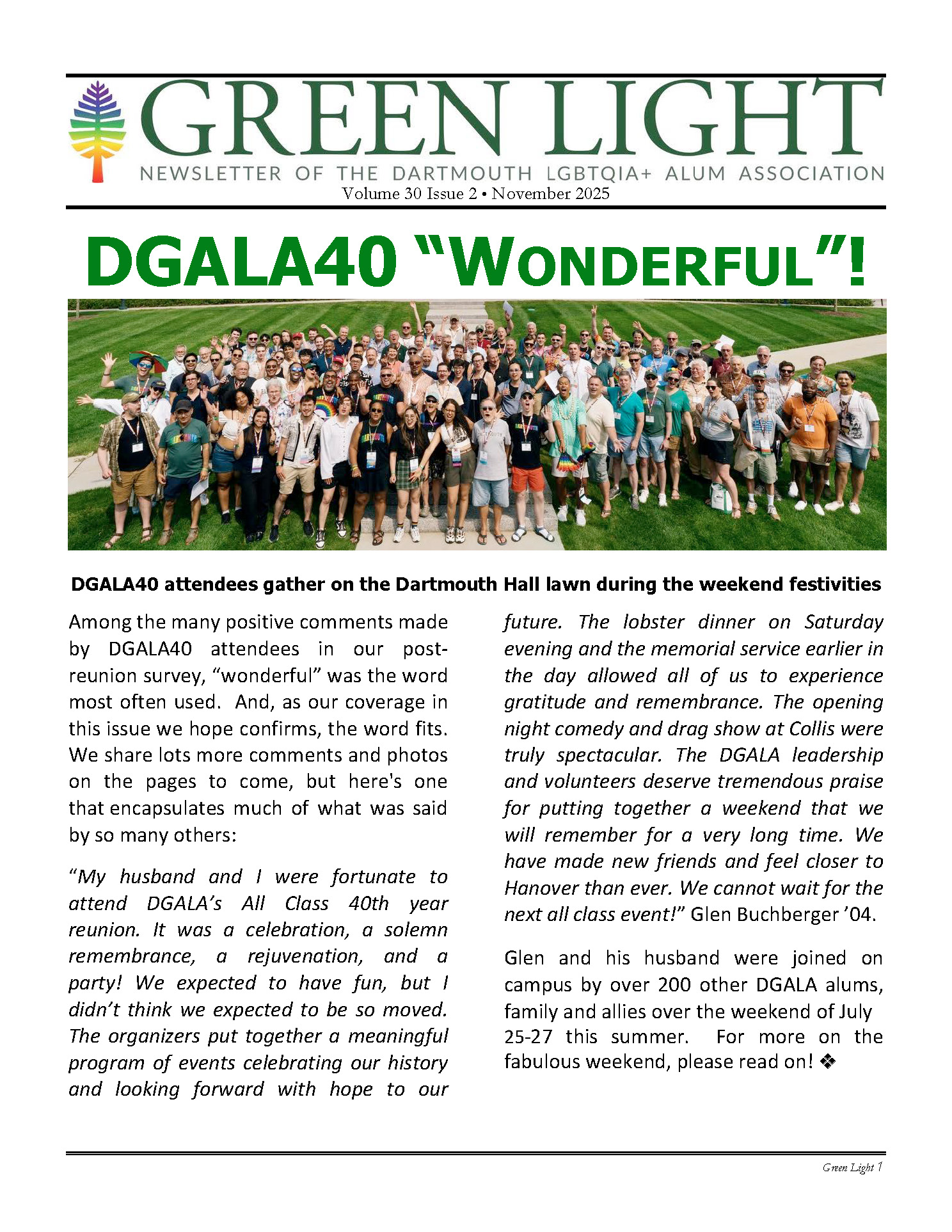
The latest issue of the GREEN LIGHT newsletter is headed out in the mail soon, but you can get this special DGALA40 Reunion edition here now.
The latest issue of the GREEN LIGHT newsletter is headed out in the mail soon, but you can get this special DGALA40 Reunion edition here now.
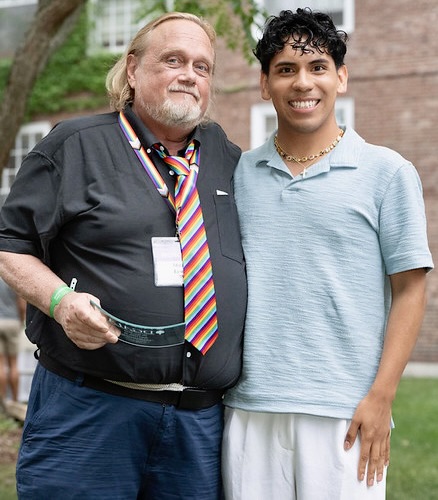
I am deeply grateful to the DGALA Board for having made possible my trip to the 40th anniversary All-Class reunion in July and for presenting me with their “Hero” award. Accepting the invitation was a challenge for me, and it took personal encouragement and support from Pete, Erik and Amanda to give me the courage to follow through.
Making the trip meant confronting the physical limitations imposed by my three-year battle with Long Covid, as well as reconciling a half century of conflicted feelings about my complicated relationship with Dartmouth. At the time I received the invitation, leaving my apartment required a lot of physical effort, and overcoming months of housebound social withdrawal.
Never having attended any Dartmouth reunion before, there’s no denying the apprehension about returning to the place that largely set the course of my life, for good or bad. I worried about how it would feel being among so many others whose grand successes in life made me less proud of my own, especially when struggling with serious current health and financial problems.
Making the decision to attend set a goal for me to build the strength and stamina that a cross-country trip would require and motivated me to begin pushing myself forward again. Even more than the award, the prospect of at last meeting in-person the fabulous “House of Lewan” drag children and seeing them perform reinforced my determination to be there.
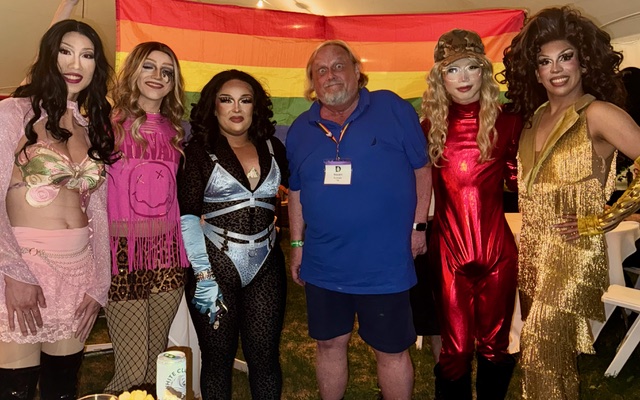
Was I even remotely prepared to handle the tropical heat and humidity, punctuated by a violent storm warning blaring exactly as I was checking in at the registration tent? Not a chance, but I did my best to damply lumber my bulk around campus, sweating as profusely as I ever did back in the bathhouse days. Did I move so slowly and require stopping for rest breaks so often that I missed about half of the activities I had hoped to attend? Yes, but the events I did make, Friday night’s Talent Show with the House of Lewan, and the al fresco awards dinner Saturday could not have filled my heart with more joy.
Somehow, my lodging assignment put me back in the same corner of Richardson where I had spent my tumultuous Freshman year—and the window framed exactly the same view I stared at during those long, lonely hours of wondering who I was and what was going to happen to me. I felt the continuity of the through-line of my life, searching for direction and answers from “out there,” when the eventual reality was that they were to be found inside me. Even the surprising jolt of adolescent “sexual tension” flashback reaction to all-male shared bathrooms and group showers took me back a half-century!
And what is a “hero” award anyway? The trip got me to go back and read my handwritten journals from those bygone days, and I even pulled up all the articles written about me from the archives of ”The D.” Somewhere I’d heard that a hero was someone who felt fear but went ahead and acted anyway. So much of for what I was being recognized wasn’t so scary at the time, but simply my wanting life to be better in those barely co-ed days for everyone who didn’t fit in the Webster Avenue mode. If anything, my “bravery” was more like naivete or foolish disregard and denial of consequences. That years later people were showing me appreciation for those sometimes silly, sometimes serious things made me realize we never quite know the extent of the impact we’ve had.
Nothing for which I’m recognized would have been possible without the friendship and hard work of so many other Dartmouth pioneers, like Bill Monsour’77 first launching Students for Social Alternatives, and Hillary Goodridge ’78 leading the women’s community. The infamous “Carnival is a Drag” show was a group effort of my Alpha Theta house siblings, especially the late Beth Krakower ‘92, and my ’79 classmate Sam Abel.
Dean Warner Traynham ’57 generous support of the Tucker Foundation created a safe space to enable Dartmouth’s first open gay community as much as Dick’s House Head Counselor Bruce Baker’s kindness and affirmation in those early Human Sexuality Growth groups. That we are celebrating this 40th DGALA reunion is testimony to Ed Hermance ’62 and Chuck Edwards A’86 organizing gay alumni in 1985 at the height of the AIDS crisis, when any hope for the future was desperately needed.
And who could have ever predicted that Dartmouth would create Triangle House in 2014 so queer students could have a place of their own? Or would officially recognize Jaime Aranzabal ’24’s petition for a drag performance troupe whose success is now winning admirers far and wide?
Too many to mention are all those who may have kept the closet door firmly closed at one time, who have later come forward to donate, volunteer and contribute to the vision of Dartmouth’s gay students and alumni taking their place as equals in the Big Green family. And that goes totally without mentioning all the straight allies who privately or publicly risked their reputations to do the right thing, bravely confronting prejudice and hate. Since the advent of social media, I’ve been surprised by how many people have reached out to apologize for past hurts, to clear their conscience, to make amends, some who I never knew by name before.
The weekend flashed by so fast that by the time Sunday morning arrived and it was time to leave, the list of things I wanted to see and do while I was in Hanover was many times longer than before I got there. Instead of enduring dark thoughts and bad memories, the verdant green grass and bright blue skies connected me with happier times I’d nearly forgotten. That’s probably why reunions are in the summer, I’d guess, rather than having us relive the trauma of 8AM classes during Winter Term.
Now that the Reunion experience is a few months past, I can report the momentum of the trip has gotten me through a round of medical testing that shows more recovery than I had thought possible, and renewed energy to reach out and re-establish social connections. At the beginning of the year, things felt pretty gloomy for me, but now day-by-day I’m finding a path toward something better. As I said when accepting the award, no matter how much my butt was kicked, Dartmouth has repeatedly brought opportunity, connection and renewal into my life. As difficult as it has been at times for me to admit, I owe Dartmouth for much of what made who I am and made my life worth living.
Thank you so much, Cheryl [Bascomb], and good evening, everyone! Welcome home! It is wonderful to have everyone back on the Green; to welcome so many of our younger alumni for their reunion weekends; and of course, to celebrate what is an extraordinary milestone: forty years of DGALA! I especially want to thank Erik Ochsner [’93, DGALA President], Kevin Perry [’04, DGALA 40th Reunion Chair], and the many, many volunteers who came together to make this weekend happen. Can we give them a round of applause?
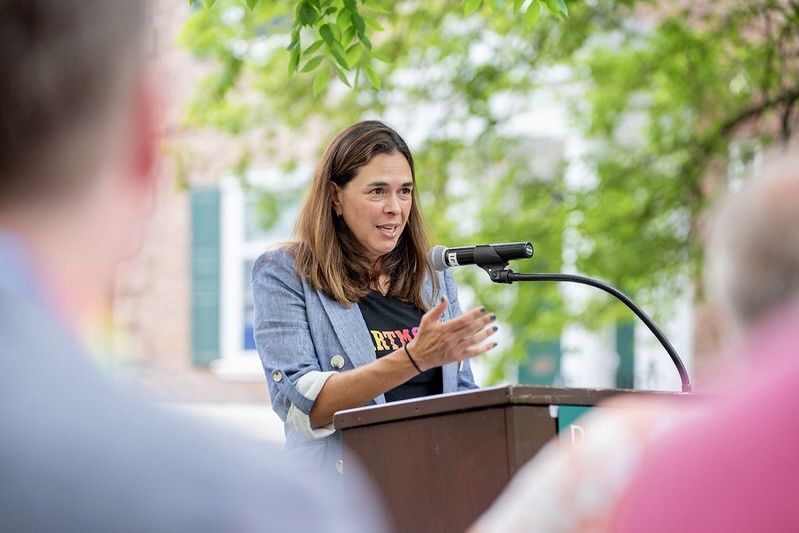
If there is one thing I have seen again and again in my first two years here … it is the tireless work that goes into building this tight-knit Dartmouth community. That does not just spring up overnight. It happens because class after class, generation after generation do the work: to welcome others in; to reach out across lines of difference; to make sure this is a place of inclusion and dignity for everyone who sets foot on our campus. And I can’t think of a more powerful
example than this DGALA community.
I don’t need to remind anyone that forty years ago, when DGALA first sought official recognition from the College … the idea was met with reluctance. And yet because of the dedication of those early pioneers like Ed Hermance, and Chuck Edwards, and Jim Gibb; because of Phil Hanlon and other leaders DGALA is honoring tonight; because of the ongoing work of so many of our students and alumni … we gather tonight at a very different moment.
A moment when DGALA is not just recognized as a part of this Dartmouth family — but is celebrated, welcomed, and valued as true partners in all we do. DGALA has been instrumental as we build the best Dartmouth we possibly can: regularly meeting with my senior leadership team; convening regional alumni gatherings; working with Triangle House to provide grants to students; and of course, collaborating with the Dartmouth College Fund for twenty-one years now, to provide scholarships to LGBTQIA+ students. In each of the past two fiscal years, DGALA members have generously funded five DGALA Scholars!
And even as we look at the remarkable work we’ve done together … we must also acknowledge this moment we’re in. We’re coming off a very eventful year, to say the least — not just for higher education, but for our country, our world. I know in LGBTQIA communities around the country, this is a moment of anxiety, even fear. I want to say very clearly to our Dartmouth family here tonight: We will always, always support our community members. We will not allow government overreach into our academic mission. And we will continue to protect and defend diversity in all forms on our campus — because we know a having a big tent and different perspectives makes ALL of us better.
That means continuing to be an inclusive campus and community — where everyone, no matter your gender identity or who you love, is valued and supported. That means continuing to provide comprehensive mental health support and gender-affirming care, as a core value — and we have an incredible team, led by our Chief Health and Wellness Officer, Dr. Estevan Garcia, who is here tonight … dedicated to doing exactly that.
And it means continuing to uphold our strict nondiscrimination policy — so that every student is provided with equal opportunities and support services.
Those values do not change no matter *who* is in office.
When we create that kind of inclusive community … it allows us to live up to our academic mission. It means we can bring exceptional young people to Hanover, from all different walks of life, so they can engage in civil discourse; teach them how to think, not what to think; and help shape them into the leaders that our world desperately needs right now. That is the mission we are doubling down on right now. That is what, together, we can achieve.
So let me offer a toast to 40 years of DGALA … to tonight’s honorees … and to our work continuing to build an inclusive community that makes us all better. Cheers!
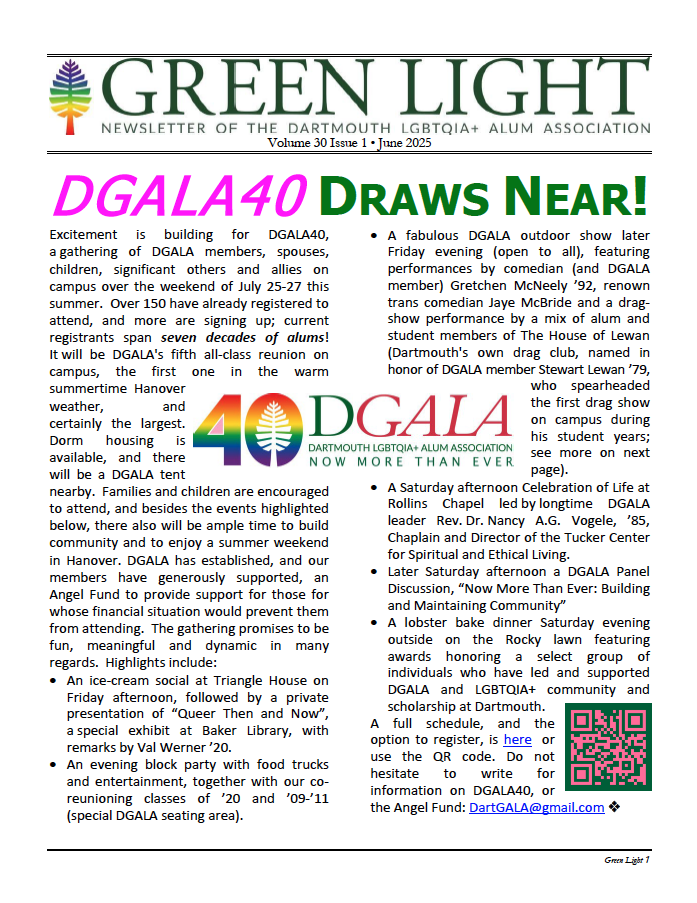
The latest issue of the GREEN LIGHT newsletter is headed out in the mail soon, but you can beat the postal service by reading it online here now.

DGALA is a 501(c)3 non-profit organization. Your donation is tax deductible as allowed by law.

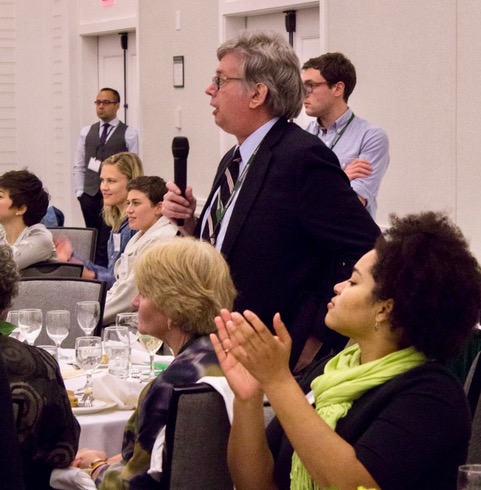
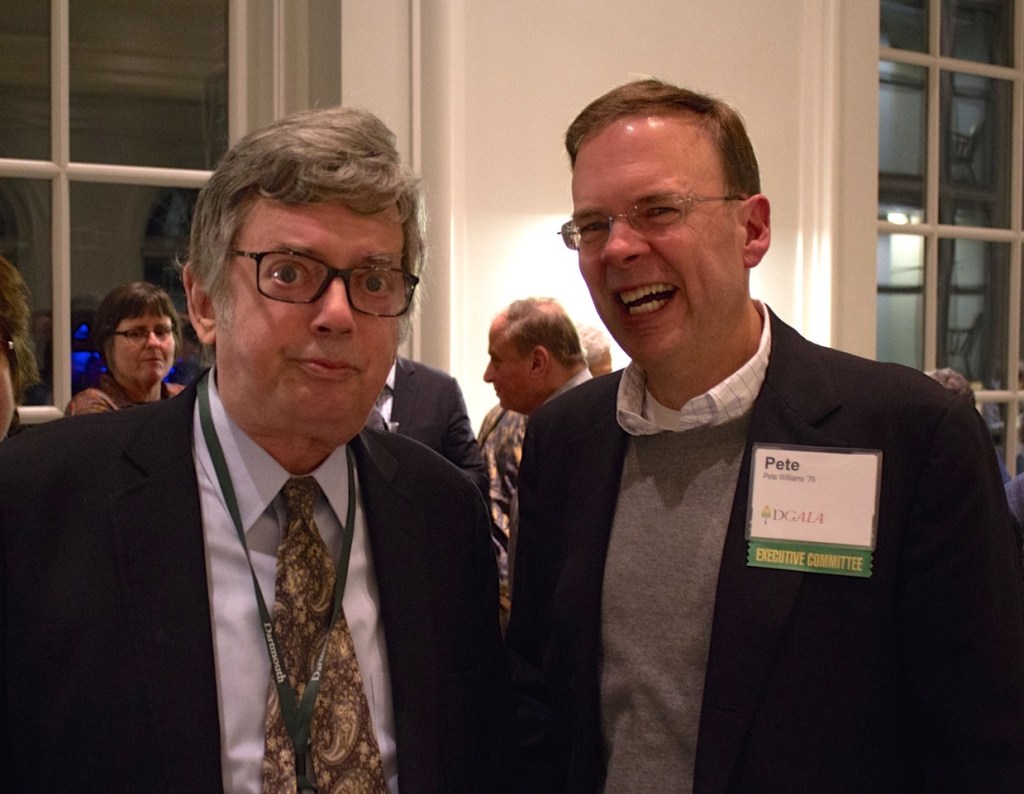
With deep regret we report the passing of Professor Peter Saccio in August of this year at age 83. DGALA honored Peter at our 20th anniversary all-class reunion on campus in 2004. In his remarks at the reunion, Saccio remembered his agonizing decision in 1984 whether to become advisor to Dartmouth’s fledgling LGBT student group. Peter ultimately said “yes,” thinking how he wished that some professor at his undergraduate college had done the same twenty years earlier. Peter remained a beloved advisor and supporter of Dartmouth’s LGBTQIA students and alums for the rest of his life.
Following Peter’s passing, DGALA reached out to our community for memories of Peter that they might share. Here are a few.
Eulogy at Peter’s Funeral by Colin Partridge ’72
To be honest, I am just as unprepared for today as I was for Peter’s unexpected Popquiz on Cymbeline when I hadn’t read it.
My name is Colin Partridge. I was Peter’s student in 1971 and 1972, a Choate resident where he was Master, and his friend for 54 yrs. When I met him in 1969, Peter was a young (if seemingly ancient to me) Dartmouth professor whose oversubscribed Shakespeare course I somehow got into. Peter believed in the power of education to transform lives, and he dedicated his life to that mission. Today, I will try to honor Peter by telling you about the effect he had on mine.
Even in my first day of Peter’s class, I was awed by his encyclopedic knowledge, his critical analyses, and the theatre he brought to Shakespeare. His passion, wit, and scholarship earned him every one of his many accolades. But in addition to his summa cum laude teaching, his office door and his professor’s heart were open to us all, as Henry V put it:
“Peter was but a man, as I am. The violet smelled to him as it doth to me. The element showed to him as it doth to me. All his senses had but human conditions.”
Peter was also there FOR us. Peter’s command of prose paved the way forward for me and hundreds of other students. I have never read the letter of recommendation he wrote. But his eloquence must have overcome the blank verse of my application. HIS letter got me accepted into medical school, my GPA did not.
His book “Shakespeare’s English Kings” guided me, hundreds of students, and thousands of theatre goers through the confusion of Henrys and Richards, and Warwicks and Norfolks in Shakespeare’s ten history plays. The book is still captivating, but Peter made Shakespeare’s kings and usurpers come live.
Astonishingly enough, he even tried to make me come alive as Spurio in Cyril Tourner’s ‘The REVENGER’S TRAGEDY.’ Peter was the faculty mentor for a senior’s honors thesis in directing. When I was far too vanilla as Spurio, the randy bastard son of the Duke, Peter gave me notes on how to act in this vivid and violent Jacobean revenge play: if I was going to seduce my stepmother, I couldn’t just SAY lustful lines, I had to play it DIRTY.
Peter was open, out, and honest decades before it was safe let alone acceptable. A brave leader of a band of brothers when most of us cowered — on stage or off, Peter fought for our silent minority with his words, his example and at least once with his fists. His believed deeply in justice, compassion, and the inherent dignity of every individual.
To be honest, Peter could turn three words into an hour-long gripping lecture. So just whatever could I say today?
An echo of Pistol from Henry IV
“Boy, bristle thy courage up; for Falstaff he is dead, And we must yearn therefore.”
Or perhaps, instead the Dartmouth motto:
Vox clamantis in deserto.
Peter WAS a voice crying in the wilderness, to me and to many other students, forceful and instructive. Peter was a teacher for all times. Just 3 months ago, Peter gave his final lecture – not in Birnham Wood but at the Woodlands — on the ghosts of Shakespeare.
Weeks ago, Peter confided that he was ready to die. I wanted to say something profound. [Imagine trying to come up with something new – let alone deep – to a Shakespearean scholar!] Instead, Peter commented on the paper I wrote on King Lear in 1972. I think I realize now why: Cordelia suffered a more enduring tragedy than Lear: she was left alone to grieve.
As a farewell to Peter today I turn to Hamlet (as Peter almost certainly would have done) for a line with which you will all agree: “He was a man, take him for all in all, I shall not look upon his like again.”
Eulogy at Peter’s Funeral by Jeff Hoover ’88
Good morning.
My name is Jeff Hoover, Dartmouth class of 88. It’s difficult for me to stand here and speak to you on this occasion for so many reasons. One is that in the back of my mind I suppose I always hoped Peter would be available to speak at my funeral or memorial service someday.
That would have guaranteed thoughtful and thought-provoking observations delivered with just the right mix of sorrow, consolation, wit and economy.
I don’t have to tell most of you that words were Peter’s life, and he used them like few others. I like to think he saw himself in competition with his idol Shakespeare, whom he elevated and demystified over a lifetime. In a profile in the Dartmouth Alumni Magazine in 2001, he said that he, quote, “fell in love with the power of words” at age 14, when reading the lines “let us sit upon the ground/And tell sad stories of the death of kings” from Richard the Second. In the same profile, he made a point of saying that “Shakespeare knew more words than God” as he used 30,000 different words compared with just 10,000 in the Bible (according to Peter).
I have little doubt that Peter could comfortably use all of those 30,000 words. Probably many of them were mentioned at least once in the audiotapes he began recording in the 1990s for The Great Courses. I highly recommend listening to some of these recorded lectures. You can find many clips online.
They are terrific. In them, he is passionate, relevant and quite funny at times. One of my favorite bits is from a talk on the Shakespeare authorship question. Peter says the following, in a tone mixing exasperation and confidence:
“When I tell people I teach Shakespeare for a living, I’m always certain to be asked, well, tell me, did he really write those plays? I shouldn’t complain. People with any kind of job have to get used to some idiot question or other. And it’s better to be a Shakespearean than a proctologist.”
Knowing his talents and curiosity about most things in life, I think Peter would have been an excellent proctologist if he’d chosen to go down that road. But I am one of many who are better off that he didn’t. As a scholar, teacher and mentor, Peter not only knew a lot of words, but he knew when to use them…and as crucially, when not to.
That was especially important to me, an erratic and confused young man trying to come to terms with being gay at Dartmouth in the mid to late 1980s. By then, Peter had become involved in supporting the gay and lesbian students’ group and was perhaps the most public gay person on campus. This was not easy for him and it was not a role he ever thought he’d play. Peter wasn’t a loud voice or a strident advocate by nature. But what he offered was just as valuable for any cause and exactly what I needed then — he was approachable, measured, calm, reassuring and discreet. In other words, a friend.
I first got up the courage to talk to him about the ‘bigger picture’, as I suppose you’d call it, during office hours when I was taking his Modern British drama course. (I wasn’t an English or drama major, but I’d made an uncharacteristically wise decision to take his course anyway after hearing so much praise from other students.)
He was immediately welcoming and it was such a relief for me to unburden or to simply feel less tense for a while. After that, we met frequently the rest of my time at Dartmouth. Then, and throughout the decades I knew him afterwards, he was a caring conversationalist no matter the circumstances. He listened, prodded when it was just right, and knew when a sympathetic ear with no judgement was needed.
It’s hard these days to overstate the value of such comfort and encouragement. We didn’t have social media to turn to, for better or worse, and the surging AIDS crisis was terrifying both for our potential physical health and our ability to be safe overall in a world where we were often blamed. His willingness to put himself out there, and for so long and for so many people, was a blessing with thousands of positive impacts that continue to ripple.
Peter’s support extended to my professional life as well. He and his partner Jim Steffenson helped me get my first job after college, working at a literary agency for 12,000 dollars a year. That was almost as dismal of a salary then as it would be now. But it was a leg up, and an entry into New York City and the world of adult work that I wouldn’t have had otherwise.
Peter remained a constant in my life for years after, especially when he regularly visited New York with or without Jim for the theater or other activities. In later years I was proud to be able to give back to him a little, especially after Jim died. Peter came to New Haven several times when my partner and I were living there, including for Thanksgiving once, and twice a year or so I tried to visit the Upper Valley and take him out to dinner at his beloved Hanover Inn or somewhere else with good cocktails, comfortable chairs and a slow pace.
The final few years were difficult for him as he faced repeated health challenges. Yet Peter remained Peter — frequently irascible and a voracious reader with opinions both sharp and generous of everything from the New York Times to LA crime thrillers by Michael Nava featuring a gay protagonist. Whenever I saw him during those difficult times the last few years, he asked about me and all that was happening in my life even as I was assuming it should be all about him.
I am honored and grateful to have had Peter Saccio in my life, and I miss him dearly.
Thank you.
Memories by Sam Abel-Palmer ’79
Where to begin? Like pretty much everyone in this group, my memories of Peter start with Shakespeare I. Of course, Peter was a captivating lecturer and brilliant scholar. As a Drama major, I enrolled in every course he offered. As wonderfully theatrical as his large Shakespeare lectures were –he loved an audience – it was in his smaller seminars that you really appreciated the depth of his knowledge. And the best part was that he invited the whole class to his home for dinner – a practice I dutifully imitated in my later teaching career.
Beyond the classroom, Peter was actively engaged with the Dartmouth Players, regularly taking on roles and supporting our work. I especially remember a production of the Harold Pinter Revue Sketches that a group of us pulled together at the start of my senior year to present for Freshman Week. Peter took on several roles on very short notice, and I can still see his hysterically funny and unnerving performance in “Interview” – which, in a true act of devotion to his art, he performed without his toupee (the one and only time I saw that).
As a teacher and mentor, Peter was fiercely loyal to his students, avidly following their post-Dartmouth paths. He could, of course, be quite demanding, even blunt. I recall sitting in his office in Sanborn discussing a draft of one of my papers, which he had thoroughly dissected. I remarked apologetically that I knew my writing style tended to be pedantic. Without missing a beat he replied, “Not pedantic – Pontifical.” It was a tough lesson, but one I still hear in my head when I’m writing.
Happily, my memories of Peter did not end with graduation in 1979. In 1990, I returned to Hanover to join the Drama faculty. By then, Peter’s life partner Jim Steffenson had also come to Dartmouth and all three of us were (finally) out of the closet. Peter once again became a teacher and a mentor. He graciously ceded to me his role as faculty advisor to the gay student group (DAGLO was the iteration at the time, I recall), and he supported me as I eased my way into those first rounds of jousting with the administration on domestic partnership benefits and official student group recognition.
Even more joyously, Jim and Peter brought me into their community. I was admitted into the exclusive club of invitees to their private dinner parties, which were filled with wonderful food and very heady conversations. I particularly treasured the late night conversations with Peter, Jim, Bill Cook and Charles Stinson about the closeted history of Dartmouth faculty in the 60’s and 70’s, things my younger and very naive self certainly had not seen.
When I met Craig in 1992, Peter and Jim warmly welcomed him into the fold. When Craig and I had our commitment ceremony in 1994, at the First Congregational Church in Thetford, Vermont (the church where Craig’s parents were married), we were deeply honored that Peter and Jim agreed to grace our wedding ceremony with a tag-team reading of Shakespeare’s Sonnet 116 (“Let me not to the marriage of true minds . . . “). It was, to say the least, a stunning moment.
After I left Dartmouth again in 1997, we were happily able to keep in touch with Peter. I came back for Jim’s memorial (Peter never really got over losing him). We saw him a number of other times back in Hanover, and he came up to see us in Vermont to tour the lilacs–his favorite–at the Shelburne Museum. The last time we saw him was a little before the pandemic, when we were visiting Hanover and ran into him reading in a corner of the upper floor of the Dartmouth Bookstore (shortly before it closed). His body seemed tired, but his mind was as sharp as ever. And that is ultimately what I will remember about Peter – his grand, theatrical, generous, wickedly funny and deeply emotional mind and heart.
Sam Abel-Palmer ‘79
Memories by Amelia Craig Cramer ’82
When I was a student at Dartmouth, Professor Peter Saccio inspired me to deeply love Shakespeare. His assignments included not just reading the words of the plays on the page, but listening to them on recordings, reading how commentators understood and interpreted them, and then expressing my own interpretations through written essays and even acting out scenes. I spent hours in an old wingback chair in the Sanborn House Library, a heavy volume of Shakespeare’s collected works balanced on a board set across the arms of the chair, more hours in the basement of Baker Library listening to records, and yet more hours on the steps of Dartmouth Hall happily immersed in playing the role of Viola from Twelfth Night.
But what is most deeply etched in my memory of my undergraduate education at Dartmouth is Professor Saccio lecturing from the front of a large auditorium classroom, enrapturing me with his brilliance and his passion. I will forever be able to recall at will his unique voice, his theatric mannerisms, the beaming expression on his face, and his expansive gestures as he spoke about the nuances of language, the layers of meaning, the exquisite storytelling of Shakespeare.
Professor Saccio is the reason I majored in English, rather than biology. He is the reason I quit the tennis team and made academic learning my priority in college – because the practice time for tennis conflicted with the time of his class. And Professor Saccio is the reason my adult daughter, an actor, cherishes that old, worn volume of Shakespeare’s collected works that I passed on to her, knowing it was one of my most prized possessions.
Years after I graduated, when I was executive director of GLAD in Boston and had time to visit Dartmouth on a regular basis, Peter Saccio became my colleague and friend. He was the Dartmouth faculty member who led efforts to support LGBT students at the college, through the Carpenter Foundation and DGALA with which I was actively involved for several years. I will never forget talking with Peter over lunch at the Hanover Inn, discussing how best to ensure that the abuses we had endured as openly gay and lesbian members of the Dartmouth community would not be inflicted upon others, how to support students from our community who were struggling. Peter’s courage, in being out of the closet at a time when it was still dangerous, and even more impressively being an activist in support of LGBT students at that time, was inspiring.
Peter’s memory will live on and be cherished not only by me, but also by his fellow scholars of Shakespeare, his Dartmouth faculty colleagues, all the students he taught, as well as all of Dartmouth’s LGBTQIA+ community.
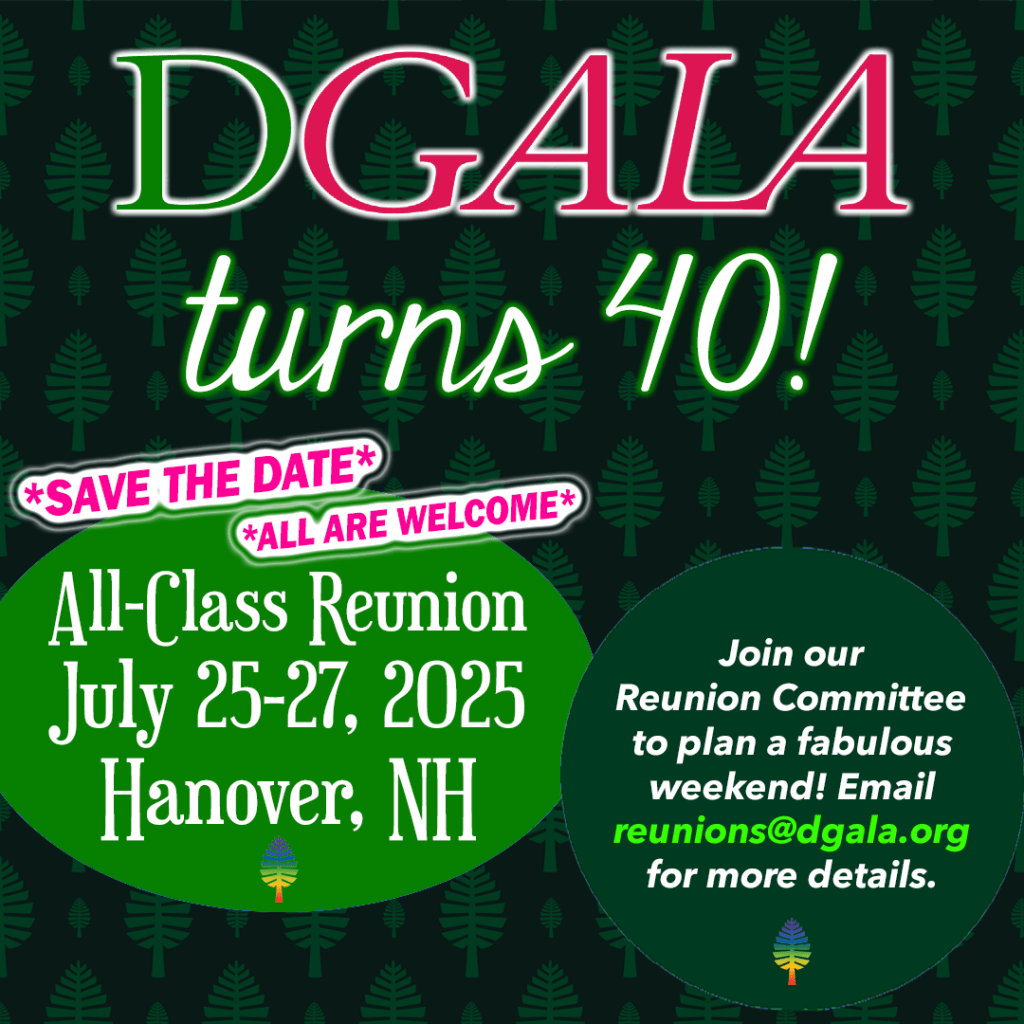
DGALA turns 40!
DGALA will celebrate its 40th anniversary with an All-Class Reunion in Hanover over the weekend of July 25-27, 2025. The Reunion will welcome alums of all classes across all Dartmouth schools for a weekend of recreation, community, learning, networking and social events.
Share your thoughts with our Reunion Survey here until Friday, September 6, 2024.
With the 2020 reunion cancelled due to the pandemic, next summer’s reunion will be a long overdue opportunity for us to gather, reconnect, reflect and reinvigorate. The hundreds of alums that have returned for prior All-Class Reunions in 2014, 2009, 2004 and 2002 will all attest to the powerful and inspiring spirit of DGALA’s All-Class Reunion weekends.
Friday, June 14 | 8-10:30pm
DGALA Cocktails
Six South Hotel
RSVP here.
Saturday, June 15 | 8:30-10am
Breakfast with the President
Irving Institute Atrium *new location*
RSVP here.
Saturday, June 15 | 1:30-2:30pm
Affiliated Groups Reception *recently added*
Irving Institute Atrium
(No RSVP needed, please just show up!)


Celebrate Pride in the Bay Area!
RSVP HERE: https://docs.google.com/forms/d/e/1FAIpQLSelTUheXn7DaYEAnl7mBZUrlcZXuy6JDT3ufIx1tYzvAexlMQ/viewform
We’ll be gathering on Thursday, June 20th at Fluid510, starting at 5:10pm.
DGALA will offer appetizers/salads and a round of drinks to all.
Fluid510 is conveniently located at 1544 Broadway in Oakland.
Right next to the 19th Street BART station.
Bring your DGALA friends or meet new ones as we celebrate Pride!
See below for the joint correspondence from the Black Alumni of Dartmouth Association (BADA), Dartmouth Association of Latino/a/x Alumni (DALA), Dartmouth Asian Pacific American Alumni Association (DAPAAA), Dartmouth LGBTQIA+ Alum Association (DGALA), Native American Alumni Association of Dartmouth (NAAAD), and Women of Dartmouth (WD).

Attn:
Sian Beilock ‘76a, President
David Kotz ‘86, Provost
Eizabeth Cahill Lempres ‘83, Th ‘84, Chair of the Board of Trustees
Wednesday, May 15, 2024
Subject: Campus Protests & Arrests | The Way Forward
Dear President Beilock, Provost Kotz, and Board Chair Lempres,
As representatives of Dartmouth’s affiliated alumni – collectively numbering half of all living alumni – we affirm our commitment to combating all forms of prejudice, discrimination, and violence. We firmly stand against antisemitism, Islamophobia, racism, sexism, ableism, hate, and all forms of intimidation based on an individual’s or community’s identity. We are dedicated to fostering an environment where all persons and cultures are treated with dignity, respect, and equality. We believe in the inherent worth and value of every human being and strive to create a society free from bigotry and intolerance.
We write in response to the decision to involve law enforcement in a nonviolent student-led protest on May 1, 2024. As representatives of the Dartmouth affiliated alumni groups, we question this decision. We are concerned that it caused harm to the individuals who were arrested, as well as to the students, faculty, staff, and area residents who were present when the officers in riot gear arrived, and to the community outside of Hanover, writ large, especially admitted students, prospective scholars, and alumni. Dartmouth should not have summoned law enforcement to arrest nonviolent protest participants. Dartmouth should not have approved law enforcement use of Dartmouth Outing Club vans to round up peaceful protestors, obstructing the orderly processes of the institution while peaceful protesters followed the spirit of the Freedom of Expression and Dissent policy.
We affirm our shared belief that diversity and inclusion are the cornerstones of an effective learning environment and a meaningful liberal arts education. It is in fulfillment of this principle that we ask that you consider our recommendations. Accompanying this joint correspondence, please find additional organizational letters and statements relevant to our concerns.
We strongly and unanimously believe that all community members – regardless of race, national origin, faith, gender identity, LGBTQIA identity, disability or any other identity or protected status – should be safe. Yet, when troopers arrived in riot gear, they threatened the safety of everyone on campus, especially those historically and disproportionately targeted and mistreated by law enforcement officers. In fact, when officers began to threaten and then make arrests, those most at risk, because of misgendering, anti-Blackness, immigration status, minority community membership, or belonging to a protected class, were severely impacted and experienced trauma as a result.
To quote three students arrested on May 1st:
“The police took my white sage, a culturally and spiritually significant item, from my pocket, and most importantly, never returned it to me upon my release.”
“The experience has made me disappointed and embarrassed that I am affiliated with this College. I am disgusted, yet not surprised…by calling the police and endangering many BIPOC students.”
“I had always thought that I was incredibly lucky to be here, and had been grateful for it all. But the College’s response…showed me how wrong I’ve been.”
In other words, even without knowing the intent, motivations, or biases of administrators and arresting officers, we know that the consequences of the arrests were experienced inequitably. The well-documented, violent arrest of Professor Annelise Orleck, for example, could have led to life-threatening injury. Any undocumented community member either participating in the protest, or simply finding themselves in the wrong place at the wrong time, would have been in danger of detention or deportation. Vulnerable community members have expressed feeling betrayed. Dartmouth, where they were promised a safe place to use their brave voices to express themselves, instantly became no different from any other place.
Neither President Beilock’s statement, dated May 2, 2024, nor her apology, published May 7, 2024, commit to a course of action to move forward from this fraught moment. That’s why alumni leaders from Dartmouth’s affinity groups reached out to fellow members of our at-large community and those on campus. We also convened to begin to identify ways in which students, faculty, and alumni could work together with Dartmouth’s Administration on short-term and long-term community strengthening goals. We see ourselves as allies in the College’s effort to create a more diverse and inclusive community.
At this critical juncture, we recognize that you are likely weighing a high number of time-sensitive questions and considerations. We believe that the following three areas should be prioritized and given your urgent attention:
Dartmouth administrators have been entrusted with community wellbeing. It is imperative to act urgently to reconcile with and restore all those who were arrested and to seek the help of experts who can guide us through community repair and the establishment of a restorative practices program, such as the one implemented at the University of Pennsylvania.
Nonviolent expressions of dissent, protest, and freedom of speech are foreseeable and normal. Part of the College’s mission is for students to find their voices. Beyond the conflict in Gaza, other points of tension are likely to emerge. The November General Election, matters before the US Supreme Court, and other events outside of Hanover, may inspire student-led demonstrations. Dartmouth’s relationship to these events and its investment in policies and programs that may be perceived to perpetuate harm are likely to lead to protests. By revisiting its Freedom of Expression and Dissent policy and rules, Dartmouth can ensure that there is not a repeat of the harms experienced on May 1, 2024. By transparently auditing its investments and moving away from the resourcing of individuals and institutions out of step with our values, Dartmouth can affirm the full humanity and equal belonging of community members who may be subject to harassment or trauma due to their background, status, or identity, and fulfill its mission of preparing future global leaders who want to enact positive change that is inclusive and diverse.
We are committed to working in concert to move Dartmouth forward. We welcome discussion of these recommendations and opportunities to collaborate in furtherance of our common goals in the weeks and months to come. We hope you keep the lines of communication open, encourage you to contact us with any questions, and ask that you explore additional ways that our groups can be helpful in bringing the greater Dartmouth community together in a constructive and positive way.
For Dartmouth and in community,
Dartmouth Affiliated Groups:
BADA | Black Alumni of Dartmouth Association
DALA | Dartmouth Association of Latino/a/x Alumni
DAPAAA | Dartmouth Asian Pacific American Alumni Association
DGALA | Dartmouth LGBTQIA+ Alum Association
NAAAD | Native American Alumni Association of Dartmouth
WD | Women of Dartmouth
Executive Officers:
Imithri De Silva Bodhinayake MED’10, Co-Chair, WD
Maria Cole ‘84, President, BADA
Sarah Gupta ‘19, Immediate Past Chair, DAPAAA
Erik Ochsner ‘93, President, DGALA
Keli’i Opulauoho ‘96, P ’26, Co-President NAAAD
Christine Benally Peranteau ‘06, Co-Chair, WD
Kially Ruiz ‘98, President, DALA
Stephanie Westnedge ‘92, Co-Chair, DAPAAA
Attachments:
CC:
Jeffrey M. Blackburn ’91, Charter Trustee
Constance W. Britton ’89, Charter Trustee
Jeffrey M. Crowe ’78, Alumni Trustee
Susan M. Finegan ’85 (Vice-Chair), Alumni Trustee
James S. Frank ’65, Charter Trustee
Odette A. Harris ’91, Alumni Trustee
Susan S. Huang ’84, Charter Trustee
Neal K. Katyal ’91, Charter Trustee
Gregg R. Lemkau ’91, Alumni Trustee
Richard W. Lewis ’84 (Vice-Chair), Charter Trustee
Christopher H. Lord ’86, Charter Trustee
Elizabeth Mahoney Loughlin ’89, Charter Trustee
David M. McKenna ’89, Charter Trustee
Jane Pfaff Novak ’92, Charter Trustee
Shonda L. Rhimes ’91 H’14, Charter Trustee
Erica Ruliffson Schultz ’95, Charter Trustee
Joyce A. Sackey, M.D. ’85 MED ’89, Alumni Trustee
Todd B. Sisitsky ’93, Charter Trustee
Scott M. Stuart ’81, Charter Trustee
Governor Christopher T. Sununu
Jacob P. Tapper ’91, H’17, Charter Trustee
Hilary C. Tompkins ’90, H’19, Alumni Trustee
Barbara Will, Vice Provost for Academic Affairs
Kenya Tyson, Senior Associate Provost
Dean Lacy, Vice Provost, Faculty Affairs
Dean Madden, Vice Provost, Research
Eric Fossum, Vice Provost, Entrepreneurship & Technology Transfer
Scott C. Brown, Dean of the College
Susanne Mehrer, Dean of the Libraries
Michael W. Davis, Vice President for Information Technology & Chief Information Officer
Matt S. Duncan, Special Advisor to the Provost on Student Mental Health
Laura A. Ogden, Special Advisor to the Provost on Climate and Sustainability
Elizabeth Smith, Dean of Faculty
Duane Compton, Dean, Geisel School of Medicine
Alexis Abramson, Dean, Thayer School of Engineering
Matthew J. Slaughter, Dean, Tuck School of Business
Jon Kull, Dean, Guarini School of Graduate & Advanced Studies
Cheryl A. Bascomb ‘82, Vice President, Dartmouth Alumni Relations
Justin Anderson, Senior Vice President for Communications
LaMur Bunts, Chief Transformation Officer
Lee Coffin, Vice President and Dean of Admissions and Financial Aid
Shontay Delalue, Senior Vice President and Senior Diversity Officer
Scott Frew, Chief Financial Officer
Estevan Garcia, Chief Health and Wellness Officer
Mike Harrity, Haldeman Family Director of Athletics and Recreation
Sandhya Iyer, Senior Vice President, General Counsel and Secretary to the Board of Trustees
Ann Root Keith, Chief Advancement Officer
Josh Keniston, Senior Vice President of Capital Planning and Campus Operations
Robert Lasher, Senior Vice President for University Advancement
Alice Ruth, Chief Investment Officer
Emma Wolfe, VP for Government and Community Relations
Marisa Shariatdoust, Director of Alumni Engagement
Jomysha Delgado Stephen, EVP for Strategy and Special Counsel to the President

The latest issue of the GREEN LIGHT newsletter is going out in the mail soon, but you can beat the postal service by reading it online here now.
DGALA condemns the violence committed against Dartmouth students and faculty by militarized police on May 1, and we further condemn the College administration for soliciting, enabling, and excusing this violence. It is unacceptable for police in riot gear to intimidate and assault nonviolent civilians, and, even if they were violating a school policy, it is intolerable that the administration approve such actions.
The LGBTQIA+ community has historically been a target of police violence. Police violence has long been weaponized against others in our broader community: a community that includes Black people, Latinx people, Indigenous people, and, as we’ve witnessed recently with increasing horror protestors standing up for the human rights of Palestinians. Any Dartmouth policy that summons police in riot gear to arrest peaceful, unarmed protesters is a flawed policy.
Dartmouth’s history includes peaceful student demonstrations demanding divestiture. In the winter of 1986, a series of student protests called for the College to divest from South Africa to push for an end to apartheid. Students slept in shanties on the Green and many, including LGBT students, protested at Parkhurst Hall. Ultimately, the Trustees did agree to divest, a peaceful precedent for the current students’ demands.
DGALA calls on President Beilock and her administration to drop each and every charge resulting from the protests on May 1. We further call on Dartmouth to issue an official apology for facilitating violent assaults on its faculty and students.
April 22, 2024
Dartmouth College Board of Trustees
6001 Parkhurst Hall
Hanover, New Hampshire 03755
To the Dartmouth College Board of Trustees:
On behalf of the Board of Directors of DGALA, I write to express our great dismay that the College has announced plans to award an Honorary Doctorate Degree in June to an individual who is an employee of Uganda Christian University (“UCU”), an aggressive denier of LGBTQIA+ rights.
UCU is chartered by and closely affiliated with the government of Uganda. Uganda is the nation with the severest laws on Earth against LGBTQIA persons. Its “Anti-Homosexuality Act” provides for the death penalty or life imprisonment for sexual relations between persons of the same sex, and imprisonment for up to twenty years for “promotion or recognition of sexual relations between persons of the same sex.” UCU likewise expects all staff members and students to conform to their [Statement of Faith] rule and “shun all sexual immorality polygamy, adultery, fornication and homosexual practice.” UCU has publicized the June honorary degree in conjunction with fundraising efforts.
We do not know the individual who is to receive the honorary degree. Our concern is that Dartmouth appears to signal its support of Uganda’s horrific laws by honoring anyone potentially complicit with them. Without diminishing the honoree’s contributions to the College, we call upon the College to issue a statement condemning Uganda’s violations of human rights so as to make clear that the College does not support them.
Sincerely,
Erik Ochsner ‘93
President
cc: Members of the Council on Honorary Degrees
Ann Root Keith
Bob Lasher
Jomysha Delgado Stephen
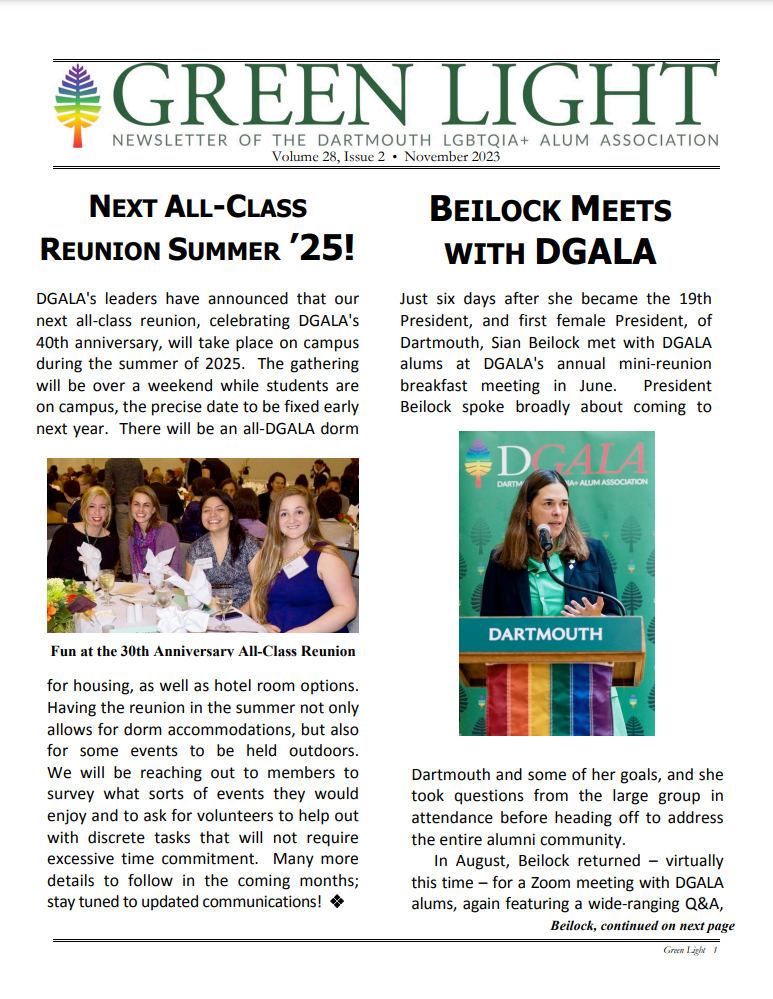
Catch up on the latest from DGALA in the November 2023 Issue of the Green Light:
Please join the Dartmouth Club of Hawaii in supporting the Wiwoʻole Maui Benefit Concert on Saturday, August 19 via http://www.kaainamomona.org at
WIWOʻOLE MAUI BENEFIT CONCERT
(LIVESTREAM) | SATURDAY, AUGUST 19, 2023
12:30-3:30pm Hawaii
3:30pm Pacific / 4:30pm Mountain / 5:30pm Central / 6:30pm Eastern
A #MauiStrong Benefit Concert Led
by Maui’s Celebrated Recording Artists & Hālau
Wiwoʻole in native Hawaiian means ‘fearless, brave, bold, and courageous.’ In this historic occurrence of unprecedented and catastrophic loss, the unifying and healing power of mele (music) has summoned Maui’s celebrated recording artists and hālau to gather for the Wiwoʻole Maui Benefit Concert (Livestream) on Saturday, August 19, 2023 live-streamed from Grand Wailea, A Waldorf Astoria Resort. Wiwoʻole #MauiStrong is dedicated to raising essential disaster relief funds urgently needed to support and sustain the victims of the August 8 Maui wildfires that affected communities across the island and devastated the historic town of Lahaina (traditionally known as Malu’ulu’olele).
Lahaina, originally a small fishing village, holds significance to Hawai’i as it was chosen by King Kamehameha II, to be the revered royal capital of the Hawaiian Kingdom from 1820-1845. Today, the Lahaina wildfire is now the deadliest in U.S. history in more than a century.
Wiwoʻole Maui Benefit Concert (Livestream), presented by Grand Wailea, The Office of Hawaiian Affairs, KITV4 News, Pacific Media Group, and emceed by, Malika Dudley. will be live-streamed worldwide on August 19, 2023 from 12:30 p.m. – 3:30 p.m. Hawai’i Standard Time on www.kaainamomona.org and across participating artists’ social media platforms.
Proceeds from Wiwoʻole #MauiStrong will be stewarded through Native Hawaiian 501(c)(3) ‘Āina Momona [EIN 82-1366588] at WIWOʻOLE MAUI BENEFIT CONCERTand the Maui Strong Fund at The Hawai’i Community Foundation [EIN 99-0261283].
Participating Artists include GRAMMY® and Nā Hōkū Hanohano Award Winners: (listed alphabetically. line-up subject to change without announcement)
• AMY HĀNAIALIʻI – @hanaialii
• CODY PUEO PATA – @kumupu
• EKOLU – @ekolumusic
• HOAKA – @hoakamusic
• KALANI PEʻA – @kalanipeamusic
• KANEKOA – @kanekoamusic
• KAMAKA KŪKONA – @kamaka_kukona
• KIMIÉ MINER – @playkimie
• KŪIKAWĀ – @kuikawa_music
• PIʻILANI ARIAS – @piilanimusic
• RAIATEA HELM – @raiateamusic
• WAIOLOHIA – @waiolohiamusic
• HĀLAU O KA HANU LEHUA, KUMU HULA KAMAKA KŪKONA – @halau_o_ka_hanu_lehua
• HĀLAU KEKUAOKALĀʻAUʻALAʻILIAHI, NĀ KUMU HULA ILIAHI AND HAUNANI PAREDES – @kekuaokalaauailiahi
• HĀLAU NĀ LEI KAUMAKA O UKA, KUMU HULA NĀPUA SILVA – @napuamusic
AND MORE…

You must be logged in to post a comment.